Leading Cause of Death in Each State That They Dont Want You to Know About
In 2019, the acme ten causes of death deemed for 55% of the 55.4 million deaths worldwide.
The top global causes of expiry, in social club of total number of lives lost, are associated with iii broad topics: cardiovascular (ischaemic heart disease, stroke), respiratory (chronic obstructive pulmonary illness, lower respiratory infections) and neonatal weather – which include nascence asphyxia and birth trauma, neonatal sepsis and infections, and preterm birth complications.
Causes of decease tin exist grouped into three categories: catching (infectious and parasitic diseases and maternal, perinatal and nutritional conditions), noncommunicable (chronic) and injuries.
Leading causes of death globally
At a global level, 7 of the 10 leading causes of deaths in 2019 were noncommunicable diseases. These seven causes accounted for 44% of all deaths or 80% of the top 10. However, all noncommunicable diseases together accounted for 74% of deaths globally in 2019.
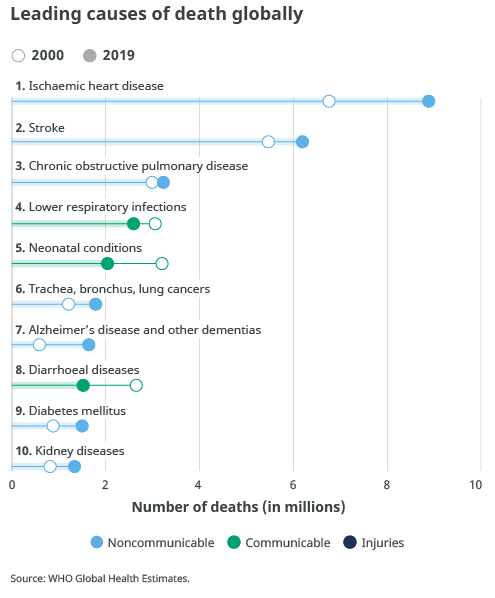
The world's biggest killer is ischaemic heart illness, responsible for sixteen% of the world'southward total deaths. Since 2000, the largest increase in deaths has been for this illness, rising past more two million to viii.9 million deaths in 2019. Stroke and chronic obstructive pulmonary illness are the 2nd and 3rd leading causes of death, responsible for approximately 11% and half dozen% of full deaths respectively.
Lower respiratory infections remained the world's nearly deadly catching illness, ranked as the fourth leading cause of death. Even so, the number of deaths has gone downwardly substantially: in 2019 information technology claimed 2.vi 1000000 lives, 460 000 fewer than in 2000.
Neonatal conditions are ranked fifth. However, deaths from neonatal conditions are one of the categories for which the global decrease in deaths in accented numbers over the by 2 decades has been the greatest: these weather killed ii 1000000 newborns and young children in 2019, 1.ii million fewer than in 2000.
Deaths from noncommunicable diseases are on the rise. Trachea, bronchus and lung cancers deaths have risen from i.2 1000000 to 1.8 million and are now ranked 6th among leading causes of death.
In 2019, Alzheimer's illness and other forms of dementia ranked equally the 7th leading cause of death. Women are disproportionately affected. Globally, 65% of deaths from Alzheimer'south and other forms of dementia are women.
I of the largest declines in the number of deaths is from diarrhoeal diseases, with global deaths falling from two.6 million in 2000 to 1.5 million in 2019.
Diabetes has entered the top ten causes of death, following a significant per centum increase of 70% since 2000. Diabetes is also responsible for the largest rise in male deaths amongst the pinnacle x, with an eighty% increase since 2000.
Other diseases which were amid the top 10 causes of decease in 2000 are no longer on the list. HIV/AIDS is 1 of them. Deaths from HIV/AIDS have fallen by 51% during the last 20 years, moving from the world'south 8th leading crusade of expiry in 2000 to the 19th in 2019.
Kidney diseases have risen from the globe's 13th leading cause of death to the tenth. Mortality has increased from 813 000 in 2000 to 1.3 meg in 2019.
Leading causes of expiry by income group
The Earth Bank classifies the globe's economies into four income groups – based on gross national income – low, lower-centre, upper-heart and loftier.

People living in a low-income state are far more than likely to die of a communicable affliction than a noncommunicable disease. Despite the global decline, half-dozen of the top 10 causes of death in low-income countries are communicable diseases.
Malaria, tuberculosis and HIV/AIDS all remain in the top ten. Nonetheless, all iii are falling significantly. The biggest subtract amidst the elevation 10 deaths in this group has been for HIV/AIDS, with 59% fewer deaths in 2019 than in 2000, or 161 000 and 395 000 respectively.
Diarrhoeal diseases are more significant as a cause of decease in low-income countries: they rank in the top five causes of death for this income category. Nonetheless, diarrhoeal diseases are decreasing in low-income countries, representing the second biggest subtract in fatalities among the summit 10 (231 000 fewer deaths).
Deaths due to chronic obstructive pulmonary disease are particularly infrequent in depression-income countries compared to other income groups. Information technology does not appear in the superlative 10 for depression-income countries yet ranks in the top 5 for all other income groups.

Lower-middle-income countries have the near disparate elevation 10 causes of death: five noncommunicable, iv communicable, and one injury. Diabetes is a ascent cause of decease in this income group: information technology has moved from the 15th to 9th leading cause of expiry and the number of deaths from this affliction has well-nigh doubled since 2000.
As a summit 10 cause of death in this income group, diarrhoeal diseases remain a significant challenge. However, this category of diseases represents the biggest decrease in absolute deaths, falling from 1.nine million to 1.1 million between 2000 and 2019. The biggest increment in absolute deaths is from ischaemic centre disease, rising by more than 1 million to iii.1 million since 2000. HIV/AIDS has seen the biggest subtract in rank amid the previous top 10 causes of death in 2000, moving from eighth to 15th.

In upper-middle-income countries, there has been a notable rise in deaths from lung cancer, which have increased by 411 000; more than than double the increase in deaths of all 3 other income groups combined. In addition, breadbasket cancer features highly in upper-middle-income countries compared to the other income groups, remaining the but grouping with this disease in the pinnacle ten causes of expiry.
One of the biggest decreases in terms of absolute number of deaths is for chronic obstructive pulmonary affliction, which has fallen past about 264 000 to one.three one thousand thousand deaths. Even so, deaths from ischaemic heart illness accept increased past more than i.ii one thousand thousand, the largest rise in any income group in terms of absolute number of deaths from this cause.
There is but 1 communicable disease (lower respiratory infections) in the superlative 10 causes of death for upper-middle-income countries. Notably, in that location has been a 31% autumn in deaths from suicide since 2000 in this income category, decreasing to 234 000 deaths in 2019.

In high-income countries, deaths are increasing for all top 10 diseases except two. Ischaemic heart illness and stroke are the only causes of death in the height ten for which the total numbers have gone downwardly between 2000 and 2019, by 16% (or 327 000 deaths) and by 21% (or 205 000 deaths) respectively. High-income is the only category of income group in which there have been decreasing numbers of deaths from these 2 diseases. Nevertheless ischaemic eye disease and stroke accept remained in the top three causes of death for this income category, with a combined full of over ii.v million fatalities in 2019. In addition, deaths from hypertensive center illness are ascent. Reflecting a global trend, this disease has risen from the 18th leading cause of death to the 9th.
Deaths due to Alzheimer's disease and other dementias have increased, overtaking stroke to become the second leading crusade in high-income countries, and being responsible for the deaths of 814 000 people in 2019. And, as with upper-heart-income countries, only one communicable illness, lower respiratory infections, appears in the acme 10 causes of death.
Why do we demand to know the reasons people die?
It is important to know why people die to improve how people live. Measuring how many people die each year helps to assess the effectiveness of our health systems and direct resources to where they are needed almost. For case, bloodshed data can help focus activities and resources allocation amidst sectors such as transportation, food and agronomics, and the environment as well as wellness.
COVID-19 has highlighted the importance for countries to invest in ceremonious registration and vital statistics systems to allow daily counting of deaths, and straight prevention and treatment efforts. It has as well revealed inherent fragmentation in data collection systems in virtually depression-income countries, where policy-makers still do not know with confidence how many people die and of what causes.
To address this disquisitional gap, WHO has partnered with global actors to launch Revealing the Toll of COVID-19: Technical Bundle for Rapid Bloodshed Surveillance and Epidemic Response. By providing the tools and guidance for rapid mortality surveillance, countries can collect data on full number of deaths past day, week, sexual activity, age and location, thus enabling health leaders to trigger more timely efforts for improvements to health.
Furthermore, the World Health Organization develops standards and all-time practices for information collection, processing and synthesis through the consolidated and improved International Classification of Diseases (ICD-11) – a digital platform that facilitates reporting of timely and accurate data for causes of expiry for countries to routinely generate and use health information that conforms to international standards.
The routine drove and analysis of high-quality data on deaths and causes of decease, besides equally data on disability, disaggregated by age, sex and geographic location, is essential for improving health and reducing deaths and inability across the world.
Editor's note
WHO's Global Health Estimates, from which the information in this fact sheet is extracted, present comprehensive and comparable wellness-related data, including life expectancy, healthy life expectancy, mortality and morbidity, and brunt of diseases at global, regional and country levels disaggregated past age, sex and cause. The estimates released in 2020 report on trends for more than 160 diseases and injuries annually from 2000 to 2019.
Leading Cause of Death in Each State That They Dont Want You to Know About
Source: https://www.who.int/news-room/fact-sheets/detail/the-top-10-causes-of-death
0 Response to "Leading Cause of Death in Each State That They Dont Want You to Know About"
Postar um comentário